



Weekly News! 6.3.26
What a fabulous week we have had! Take a look at what we have been up to!
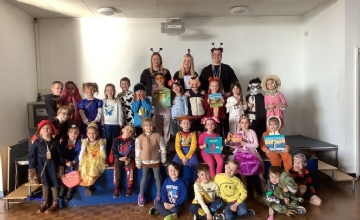
A huge thank you to all parents and carers for your fabulous efforts in helping the children prepare for World Book Day. The costumes, creativity and enthusiasm were wonderful to see!
The children had a wonderful day celebrating their love of reading. We enjoyed sharing stories, talking about our favourite books and characters, and taking part in fun reading activities throughout the day.
Thank you again for your continued support in helping us make the day so special for the children.
Math
This week in Maths we have been practising our addition skills using different practical resources to help us understand how numbers work.
At the beginning of the week, we used ten frames and place value counters to practise adding two 1-digit numbers. The children selected a number sentence and then filled their ten frames with counters to represent the numbers. We then partitioned the smaller number so that we could make ten first, which helped us add the numbers more easily. This method helps children see how numbers can be broken apart and recombined.
Later in the week, we practised adding 2-digit numbers and 1-digit numbers using the regrouping into tens and ones strategy. The children used Base 10 resources to support their understanding. They added the ones first and, when needed, regrouped them into a new ten.
We also continued practising our number bonds to 20, helping the children become more confident in recognising different pairs of numbers that make 20.
 Next week we will be looking at doubling numbers.
Each week, we will share a key maths fact. This week, we are learning:
Addition Facts:
-
2 + 0 = 2
-
0 + 2 = 2
Read, Write Inc. (RWI)
This week, the children have shown fantastic enthusiasm as we revisited previously taught sounds and continued to strengthen their phonics reading skills. It has been a joy to see their growing confidence and engagement in learning.
We have been focusing on several key areas, including recognising “special friends” — groups of letters that work together to make a single sound. The children are becoming increasingly confident at spotting these in words and using Fred Talk, blending, and segmenting to support their reading. They have also been practising reading green words and learning a range of red (tricky) words.
Alongside this, we have seen great progress in handwriting. The children are taking increasing care with letter formation, using capital letters appropriately, and remembering to add full stops to complete their sentences. Their handwriting is becoming clearer and more controlled each week, which is wonderful to see.
To support your child at home, you can help by spotting “special friends” in everyday words, blending sounds together to read full words, and encouraging regular practice for an extra boost. We are finding spotting chatty friends like; a-e, e-e, i-e, o-e and u-e a particular challenge, so any practise with spotting these would be great.
Reading at Home
-
Children will bring home two books each week:
-
RWI Home Book – should be read three times a week for fluency. Changed every Monday by an adult.
-
Book with coloured sticker – children can change independently, ideally in the morning.
-
-
Please ensure reading folders are placed in the trays at school.
-
Encourage your child to read at home and record it in their reading record.
-
Certificates are awarded weekly to celebrate reading achievements, and every 20 reads earns a special certificate!
If you have any questions, please speak to your child’s class teacher
Thematic
Science This Week – Grouping Animals
This week in science we have been learning about how animals can be grouped based on their characteristics. We used our prior knowledge from previous lessons to help us sort animals into the five main animal groups: mammals, reptiles, amphibians, birds and fish.
The children worked together to place different animals into the correct groups and discussed the features that helped them decide. We also talked about some tricky animals, such as whales and bats. The children learnt that whales are mammals, not fish, and bats are mammals, not birds. This is because mammals breathe air, are warm-blooded and give birth to live young. This helped us understand that scientists group animals by their characteristics, not simply by where they live or how they move.
As a challenge, the children were given mystery animal cards describing different animal characteristics. They had to decide which animal group the mystery animal belonged to, explain their reasoning using scientific vocabulary, and justify why it did not belong to the other groups.
Later in the week, we learnt that not all animals eat the same types of food. We discovered that animals can also be grouped by their diet.
-
Carnivores eat other animals.
-
Herbivores eat plants.
-
Omnivores eat both plants and animals.