



Weekly News 13.3.26
We have had a great week in Year 4. Here is what we have been up to…
Maths
In maths this week, we have been learning about volume and capacity. We learnt to read the scales on measuring containers such as beakers and measuring cylinders. The scales went in different increments, such as 1s, 2s, 10s, 5s, 20s, 50s, 100s or 200s, and some of the increments were not labelled on the scales. We learnt that 1000ml is equal to 1 litre and used this knowledge to convert between units of volume e.g. 3000ml = _____l, ½ litre = _______ml, 8500ml = ____________. We also converted volumes so that we could compare the or put them in order e.g. Compare 6l and 4500ml using a comparison sign, 4500ml = 4 ½ l so 6l > 4 ½ l.
Next week we will be learning to round, order and compare decimal numbers.
English
In English this week we have been learning about how to write persuasive texts. We identified the features of a good persuasive text in Mrs Cousins’ persuasive writing that tried to convince us that cats are the best pet ever! We then started to learn the skills ourselves. We have learnt to use modal verbs (should, must, would, ought to, may, will), use superlatives (bravest, cutest, most adventurous, most confident, most interesting, best, worst, tastiest, kindest) and to use persuasive phrases such as ‘I strongly believe that..’, ‘It is clear to see that…’, ‘Obviously,..’ and ‘Without a doubt…’
Next week we will continue to learn some more skills that help us to be very persuasive.
Thematic
In history this week, we learnt about the difference between primary and secondary sources of historical evidence. We looked at some sources of evidence about the Golden Age of Islam and worked out if they were primary or secondary sources.
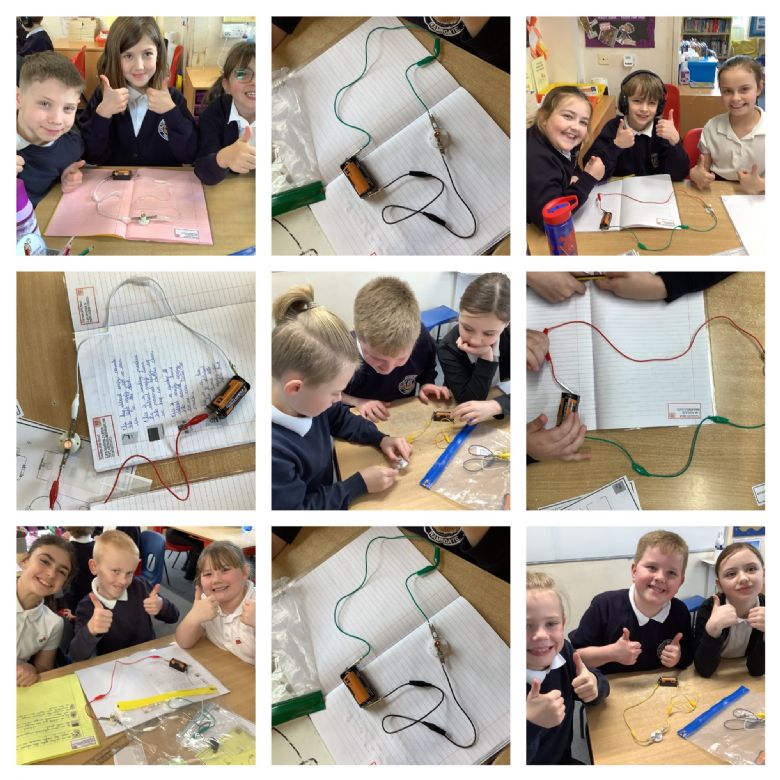
We then began our science learning for this unit and learnt about appliances that use electricity and whether they convert electrical energy into light, sound, movement (kinetic) or heat (thermal) energy. We then learnt about simple electrical circuits and electrical components such as batteries (cells), wires with crocodile clips, bulbs and buzzers. We learnt how to draw a circuit diagram using the correct symbols for the components.
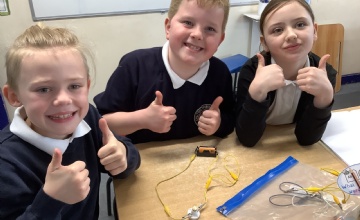
Here we are enjoying making electrical circuits, including making the bulb light and the buzzer go off!